
When Lab-Scale Chromatography Stops Working: The Hidden Challenges of Industrial Scale-Up
A purification process that works well at laboratory scale does not always translate directly to pilot or industrial production. This is particularly relevant for traditional packed-bed solid-phase chromatography, including silica-based preparative chromatography, where increasing process scale can introduce technical, operational and economic limitations that were not visible at laboratory scale.
The central challenge is to maintain purity, recovery and efficiency as production volume increases, without shifting the burden to solvent consumption, waste generation, processing time or overall cost.
Why Does Silica Chromatography Become Challenging at Industrial Scale?
Silica-based chromatography remains highly effective for small-scale purification, method development and many established preparative workflows. The challenge appears when a method that is practical at gram scale has to support kilogram-scale production.
At that point, the separation itself is no longer the only question. The complete purification process has to remain practical under manufacturing conditions. Solvent consumption, stationary phase demand, pressure limitations, processing time, waste generation and equipment utilization become central factors in process feasibility and cost.
Industrial scale-up can therefore be limited by:
– high solvent consumption,
– large quantities of chromatography media,
– solid and solvent waste generation,
– pressure drop and flow limitations,
– longer processing and solvent-removal times,
– cleaning, conditioning and column-maintenance requirements,
– reduced productivity per unit of equipment,
– higher facility and operational demands.
Why Doesn’t Chromatography Always Scale Linearly?
In practice, chromatography scale-up involves multiple interacting parameters. Increasing column dimensions, flow rate and sample loading can affect:
– pressure drop and hydraulic limitations;
– linear velocity and residence time;
– mass transfer between the mobile and stationary phases;
– axial dispersion and band broadening;
– peak shape, including fronting, tailing and peak overlap;
– loading capacity and impurity breakthrough;
– resolution and separation efficiency;
– fraction volume, product dilution and downstream solvent-removal burden;
– product recovery, cycle time and overall productivity.
A method that operates within a comfortable window at laboratory scale may therefore have a much narrower operating window at manufacturing scale. Overloading is a typical example. Higher loading may improve apparent productivity, but it can also result in broader peaks, impurity breakthrough, reduced resolution and lower product recovery.
This is why scale-up should be built into method development from the beginning. A successful laboratory method should be assessed not only by the first separation result, but by its potential to become a robust, productive and economically realistic manufacturing process.
What Role Does Solvent Consumption Play in Scale-Up?
Solvent consumption can become one of the most important economic and environmental factors in preparative chromatography. At laboratory scale, using several liters of mobile phase may be acceptable. At industrial scale, the same process concept can require hundreds or thousands of liters, depending on the separation and production volume.
Higher solvent consumption means:
– higher material costs,
– larger solvent storage requirements,
– increased evaporation and recovery demand,
– higher energy consumption,
– greater waste-management requirements,
– more demanding safety and facility requirements.
The solvent burden also continues after the chromatographic step. Fraction volume, solvent composition and product concentration influence downstream evaporation, concentration, drying, solvent recovery and waste-treatment requirements. For large-scale manufacturing, solvent efficiency should therefore be considered alongside purity, recovery, productivity and overall process economics.
How Does Stationary Phase Consumption Affect Industrial Purification?
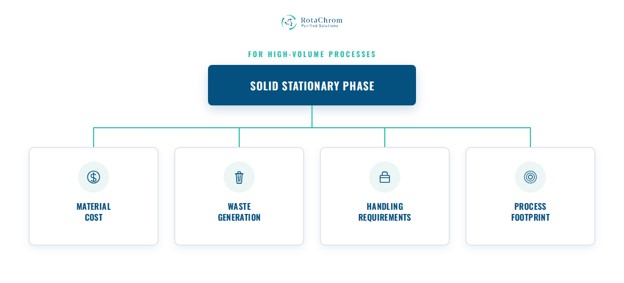
Traditional silica chromatography relies on a solid stationary phase. Increasing production scale generally requires more stationary phase, which can create both economic and operational challenges. Large quantities of silica must be sourced, handled, packed, conditioned and ultimately disposed of or replaced. The stationary phase can therefore become an important part of the overall manufacturing cost (Figure 1.), especially in repeated campaigns where column replacement, conditioning, cleaning or regeneration are required.
How Can Scale-Up Problems Be Avoided?
The most effective strategy is to define the target manufacturing requirements early. Instead of optimizing a method exclusively for laboratory performance, process developers should consider:
– required batch size and target throughput,
– target purity, recovery and acceptable product loss,
– realistic loading capacity at manufacturing scale,
– solvent consumption/kg of purified product,
– collected fraction volume and downstream concentration burden,
– stationary phase: type, required media quantity, column lifetime, packing/conditioning – needs and replacement frequency,
– processing time, cycle time and equipment utilization,
– solvent and solid waste generation,
– equipment footprint and facility requirements,
– solvent recovery and recycling strategy,
– expected long-term production capacity.
This broader perspective makes it possible to identify scale-up limitations before significant development resources have been invested in a process that may be difficult to manufacture.
A good purification strategy should therefore be developed backwards from the final process requirement, not only forwards from the first successful laboratory separation.
Could CPC Provide an Alternative to Traditional Silica Scale-Up?
For suitable liquid–liquid separations, Centrifugal Partition Chromatography, or CPC, provides a different approach to preparative purification. CPC uses a liquid stationary phase retained in the rotor by centrifugal force, eliminating the need for a packed solid stationary phase such as silica. This changes the scale-up logic by removing solid media consumption, column lifetime limitations and silica waste from the process equation.
CPC can therefore be considered when conventional packed-bed chromatography becomes limited by stationary-phase consumption, irreversible adsorption, solvent requirements, throughput or overall process economics. For particularly high-throughput requirements, production capacity can also be increased through scale-out or parallel operation, also known as farming, rather than relying exclusively on a single larger unit.
What Should a Successful Chromatography Scale-Up Achieve?
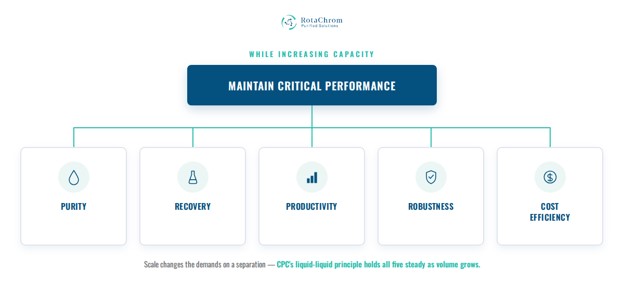
Successful scale-up is not simply about processing more material. In other words, scale-up only succeeds if higher capacity does not come at the expense of purity, recovery, productivity, robustness or process economy (Figure 2.). A purification method that performs well in the laboratory but becomes excessively expensive, solvent-intensive or difficult to operate at manufacturing scale may require a different process strategy.
When scale-up considerations are incorporated early, it becomes easier to identify the right purification strategy and avoid costly redesign later in development. Industrial purification should not be designed by simply making a laboratory process bigger. It should be designed around the requirements of the final manufacturing process.
Frequently Asked Questions
+
Why does silica chromatography become difficult to scale?
At larger scale, solvent and stationary phase requirements can increase significantly, while pressure, flow, loading, processing time, waste, and equipment requirements become more challenging. A method that is efficient at laboratory scale may therefore become less economical or practical for industrial production.
+
Does chromatography scale linearly?
Not necessarily. Increasing column size, flow rate or sample loading can affect pressure, mass transfer, peak shape, impurity breakthrough, resolution, fraction volume and product recovery.
+
What is the main advantage of CPC compared with silica chromatography for scale-up?
CPC uses a liquid stationary phase rather than a packed solid stationary phase. This eliminates the need for large quantities of silica and can simplify certain scale-up strategies while reducing solid stationary phase waste. In suitable applications, it may also provide a more flexible route for transferring purification methods from development toward larger-scale production.
+
When should scale-up be considered during purification development?
Scale-up should be considered from the beginning of method development. Evaluating throughput, solvent consumption, loading, recovery, process economics and future manufacturing requirements early can help prevent expensive changes later in the development process.