
What Is Continuous Chromatography and Why Does It Matter?
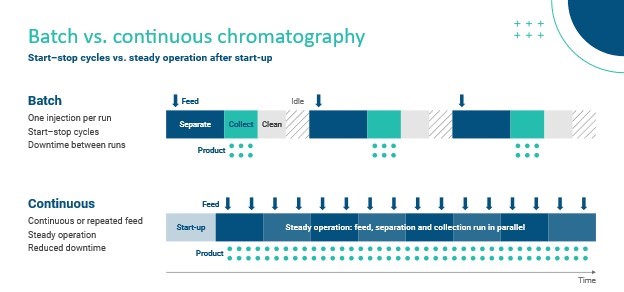
Preparative chromatography has traditionally followed a batch-based rhythm: load, separate, collect, clean and repeat. This approach is well established and effective, but it also creates unavoidable gaps between runs. At larger scale, those gaps can translate into idle equipment time, higher solvent consumption, repeated equilibration steps and lower overall productivity.
Continuous chromatography addresses this limitation by keeping the separation process running for longer periods of time. Instead of treating each injection as a separate event, the process is designed so that feed introduction, separation and product collection can continue in a coordinated way once steady operation is reached.
For manufacturers working under pressure to increase throughput, reduce overall solvent consumption and improve process economics, this can be a major advantage.
With Centrifugal Partition Chromatography, or CPC, continuous operation can be achieved through multiple dual-mode strategies, where the system alternates between ascending and descending operation to maintain separation while enabling repeated or continuous sample introduction.
Batch and Continuous Chromatography: What is the Difference?
In batch chromatography, a fixed amount of sample is injected, separated and collected in one run. The process has a defined start and end point, and the next run can begin only after the previous cycle is completed.
In continuous chromatography, the process is designed to minimize these start-stop cycles. After start-up and stabilization, feed can be introduced continuously or repeatedly, while product-rich streams are collected in a controlled and recurring way.
The difference is not only operational. It affects productivity, solvent use, equipment utilization and cost structure.
| Feature | Batch Chromatography | Continuous Chromatography |
|---|---|---|
| Sample Feeding | Single injection per run | Continuous or repeated feed introduction |
| Operation | Start-stop cycles | Steady or cyclic operation after start-up |
| Downtime | Between runs | Reduced during steady operation |
| Equipment Utilization | Limited by cycle structure | Higher in suitable applications |
| Solvent Consumption | Often higher solvent consumption per unit of product | Can be reduced through better utilization |
| Automation Need | Moderate | High |
| Operating Cost (OPEX) | Can be higher at scale | Can be lower in suitable processes |
| Upfront Investment (CAPEX) | Usually lower | Usually higher |
| Scale-up Strategy | Often requires separate scale-up work | Can support scale-up or scale-out with reduced method redevelopment |
Because the process runs for longer periods without manual interruption, continuous chromatography requires robust automation and process monitoring. The advantage is not only higher output, but more controlled and reproducible operation.
Why Does Continuous Chromatography Matter?
Continuous chromatography matters because it addresses several scale-dependent limitations at the same time.
The most important benefits are:
– higher equipment utilization;
– reduced idle time between runs;
– higher throughput in suitable applications;
– lower solvent consumption per kilogram of product;
– reduced labor demand through automation;
– improved process consistency;
– better long-term process economics.
The trade-off is higher system complexity and usually higher initial capital investment. For this reason, continuous chromatography should not be evaluated only by equipment purchase price. The relevant question is total cost of ownership: solvent use, consumables, downtime, labor, productivity, waste handling and long-term production demand.
What Is Centrifugal Partition Chromatography (CPC)?
Centrifugal Partition Chromatography (CPC) is a preparative liquid–liquid chromatography technique. Unlike packed-bed chromatography, CPC does not use a solid stationary phase such as silica or resin. Both phases are liquids. One phase is retained inside the rotor by centrifugal force and acts as the stationary phase, while the other phase is pumped through as the mobile phase.
Separation is based on the partitioning of compounds between the two immiscible liquid phases. Compounds with different partition coefficients move through the system at different speeds and can therefore be separated.
CPC can run in two modes, switched by a single valve. In descending mode, the denser phase is the mobile phase. In ascending mode, the lighter phase is the mobile phase. This ability to reverse flow is the foundation of continuous CPC.
This support-free liquid–liquid principle gives CPC several practical advantages:
– no solid stationary phase to replace;
– reduced risk of irreversible adsorption;
– flexible solvent-system selection;
– operation in ascending or descending mode;
– potential for scale-up, scale-out and continuous operation.
How Does Multiple Dual-Mode CPC Enable Continuous Operation?
CPC can operate in ascending mode or descending mode.
In ascending mode, the lighter phase is used as the mobile phase. In descending mode, the denser phase is used as the mobile phase. Because both phases are liquids, the system can switch between these two operating modes by changing the flow direction and phase role.
Multiple Dual-Mode CPC, or MDM-CPC, uses this capability deliberately. The system alternates between ascending and descending operation during the separation.
This is especially useful when compounds have similar partition behavior and partially overlap during a single-mode run. By switching modes before the overlap reaches the collection point, the system can keep target-rich zones inside the rotor longer and improve separation over repeated cycles.
The practical aim is simple: maintain separation, avoid collecting impure overlap zones and use the available rotor volume more efficiently.
This can improve purity, recovery and productivity in applications where conventional single-mode batch operation does not provide enough resolution or process efficiency.
How Does Dual-Rotor Continuous CPC Work?
RotaChrom’s continuous CPC concept uses interconnected CPC units operated in a coordinated MDM configuration. The system can be operated with different injection strategies depending on the separation objective. Injection at the front of the rotor system can increase the effective separation path and improve resolution for closely related compounds. Injection between the rotors can support continuous or repeated feed introduction, creating a more production-oriented operation with sustained output.
With multiple pumps and automated switching between ascending and descending modes, both liquid phases can alternately act as mobile and stationary phases. Less-retained components can be directed toward one outlet, while more-retained components are directed toward the other, depending on the operating strategy.
Continuous CPC belongs to the broader family of continuous countercurrent separation technologies. It shares conceptual similarities with approaches such as simulated moving bed (SMB) chromatography, true moving bed (TMB) concepts, sequential CPC and trapping MDM, but it remains distinct because CPC uses two liquid phases instead of a packed solid stationary phase.
Why Continuous CPC Is Especially
Relevant for Chiral Separations
Chiral separation is one of the strongest application areas for CPC. Enantiomers are often difficult to separate because they have nearly identical physicochemical properties. In conventional chromatography, chiral separation usually depends on a chiral stationary phase, which can be expensive, sensitive and limited by column lifetime, loading capacity and adsorption behavior.
CPC offers a different route. Chiral selectors can be dissolved in one of the liquid phases, allowing enantioselective partitioning without immobilizing the selector on a solid support.
This can be useful when:
– enantiomers are difficult to resolve because their physicochemical properties are nearly identical;
– solid chiral stationary phases become expensive at preparative scale;
– recovery and loading capacity are critical;
– irreversible adsorption must be avoided;
– the chiral selector can be recovered or reused with the liquid phase.
For difficult chiral systems, MDM and continuous CPC can further intensify the process by repeatedly improving the separation between closely partitioning enantiomers. The key is not that CPC replaces every chiral chromatography method, but that it offers a scalable liquid–liquid alternative when the selector, solvent system and partition behavior are suitable.
Where Continuous CPC Can Add Value
Continuous CPC is most relevant when the separation is difficult, the production volume is meaningful and batch operation becomes inefficient.
Potential application areas include:
– pharmaceutical intermediates and APIs;
– chiral separations;
– natural products and botanicals;
– nutraceutical ingredients;
– cosmetic actives;
– sensitive or adsorption-prone molecules;
– complex crude extracts requiring scalable fractionation.
Because CPC is silica-free, it can also be attractive when solid stationary-phase cost, column lifetime, irreversible adsorption or waste generation become limiting factors.
The main value is not that CPC performs the same job as packed-bed chromatography. It adds a different separation principle to the process toolbox. For some applications, that difference can reduce solvent burden, improve recovery, increase productivity or make scale-up more realistic.
Conclusion
Continuous chromatography is not only a faster version of batch chromatography. It changes the way purification capacity is generated. By reducing start-stop operation and improving equipment utilization, continuous processes can increase throughput and improve long-term process economics.
In CPC, continuous operation becomes especially interesting because the system is based on two liquid phases and can switch between ascending and descending modes. This creates a flexible platform for difficult separations where batch operation may be limited by resolution, recovery, productivity or cost.
For applications such as chiral separations, natural products and high-value pharmaceutical purification, continuous CPC offers more than higher throughput. It offers a different way to build a scalable purification process.
Frequently Asked Questions
+
What is continuous chromatography in simple terms?
Continuous chromatography is a purification process where the sample is fed in nonstop and purified product is collected nonstop. Unlike batch chromatography, which runs one injection at a time with pauses in between, continuous chromatography operates as a single ongoing process with no defined start or end.
+
Is continuous chromatography more cost-effective than batch chromatography?
Over the long term, usually yes. Continuous chromatography lowers operating costs by reducing solvent use, raw material consumption, and downtime, while increasing throughput and yield. The initial capital investment is higher, so manufacturers should evaluate total cost of ownership rather than purchase price alone.
+
Can Centrifugal Partition Chromatography (CPC) be run continuously?
Yes. CPC can operate continuously using multiple dual-mode (MDM) operation, which alternates between ascending and descending flow modes. With one or two interconnected CPC units, such as a dual-rotor continuous CPC system, sample can be injected without interruption for sustained production.
+
What is the difference between continuous CPC and simulated moving bed (SMB) chromatography?
Both are continuous separation concepts, but they use different stationary-phase principles. SMB relies on packed columns with a solid stationary phase, while CPC is a support-free liquid–liquid technology using two immiscible liquid phases.
+
Which compounds are best suited for continuous CPC purification?
Continuous CPC is most relevant for compounds that are difficult to separate in simple batch mode, including molecules with similar partition behavior, chiral compounds, natural products, sensitive compounds and complex extracts where recovery, loading, solvent use or scalability are important.
In chiral separation, CPC can use dissolved chiral selectors in one of the liquid phases instead of immobilized chiral stationary phases. This can reduce stationary-phase cost, improve flexibility and support preparative-scale enantioseparation when suitable partition behavior and selectivity can be achieved.