
Understanding CPC Operation Modes: Ascending, Descending and Multiple Dual-Mode (MDM)
Flexibility of liquid-liquid chromatography
Choosing the right operating mode is one of the most important decisions in Centrifugal Partition Chromatography (CPC) method development. Solvent-system selection and partition coefficients (Kd) determine whether a separation is chemically feasible. However, the operating mode determines how that partition behavior is translated into an actual chromatographic process.
In CPC, both phases are liquids. One phase is retained inside the rotor as the stationary phase by centrifugal force, while the other phase is pumped through as the mobile phase. By changing which phase is mobile and which phase is stationary, the same solvent system can give very different elution behavior, peak shape, recovery and productivity. This is why ascending mode, descending mode and multiple dual-mode operation should not be seen only as equipment settings. They are method-development tools.
This article explains the three primary CPC operating modes: Ascending, Descending and Multiple Dual-Mode (MDM) and when each should be considered.
What is ascending mode in chromatography?
In ascending mode, the denser lower phase (most often aqueous) is retained as the stationary phase inside the rotor by centrifugal force, while the lighter upper phase acts as the mobile phase. The lighter mobile phase moves against the centrifugal field, from the outer part of the rotor toward the axis of rotation. This is why the mode is called ascending.
Ascending mode is often normal-phase-like in terms of phase orientation, because the denser, more polar lower phase is retained as the stationary phase while the lighter organic phase is used as the mobile phase. This is only an analogy based on phase polarity, the actual CPC separation mechanism remains liquid–liquid partitioning.
What is descending mode in chromatography?
In descending mode, the phase roles are reversed:
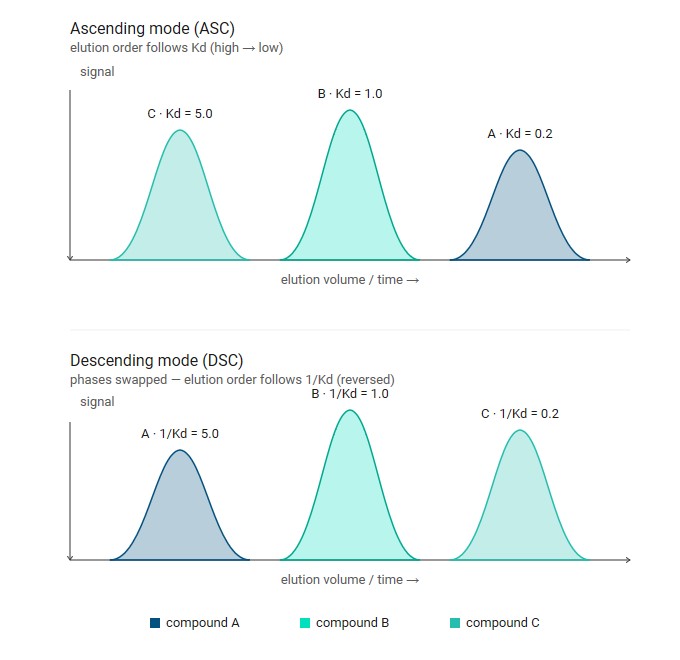
The lighter organic phase becomes the stationary phase, while the denser lower phase is pumped through the rotor as the mobile phase. The denser mobile phase moves in the direction of the centrifugal field, from the axis of rotation toward the outer part of the rotor. This is why the mode is called descending.
Descending mode can provide a different separation behavior from ascending mode, even with the same solvent system. This is because the mobile and stationary phases are exchanged, which changes the way the compound moves through the rotor and how long it remains in contact with each phase.
Descending CPC can be described as reversed-phase-like in many common solvent systems, because the less polar organic upper phase is retained as the stationary phase, while the more polar lower phase moves through the rotor as the mobile phase. That resembles reversed-phase HPLC in terms of phase polarity arrangement: less polar stationary phase, more polar mobile phase.
One of the strengths of CPC is that switching between ascending and descending modes requires no replacement of a solid stationary phase. Since both phases are liquids, operators can simply reverse the flow direction and exchange the roles of the solvent phases, offering significantly greater flexibility than conventional preparative chromatography.
What is Multiple Dual-Mode (MDM) in chromatography?
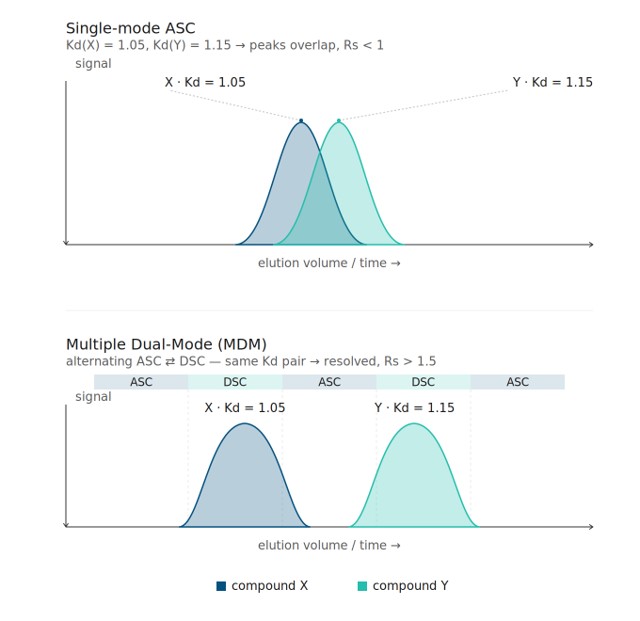
While ascending and descending modes are highly effective for many applications, some separations remain challenging, especially when the target compound and impurities possess very similar partition coefficients (Kd).
This is where Multiple Dual-Mode (MDM) can provide an additional level of separation control.
Rather than operating in only one direction, MDM periodically alternates between ascending and descending modes during the same purification process. Each switch changes the direction of flow and exchanges the mobile and stationary phases, allowing compounds that partially overlap to separate further with every cycle (Fig. 2.).
The result is significantly improved resolution while maintaining high product recovery.
Why use Multiple Dual-Mode?
Multiple Dual-Mode operation offers several important advantages:
– improved separation of compounds with similar Kd values;
– higher achievable product purity in difficult separations;
– better recovery of partially overlapping target fractions;
– improved use of the available rotor volume;
– reduced need for repeated batch runs or additional purification steps in suitable cases;
– a useful foundation for continuous CPC operation.
Because CPC uses two liquid phases instead of a packed solid stationary phase, repeated mode switching can be performed without damaging a solid bed or requiring column repacking. This gives CPC a unique operational flexibility compared with traditional preparative chromatography.
Multiple Dual-Mode and Continuous CPC
Multiple Dual-Mode technology also forms the foundation of Continuous CPC.
RotaChrom’s Continuous CPC platform combines two interconnected CPC units operating in a coordinated MDM configuration. Instead of processing one batch after another in a conventional sequence, the system enables continuous or repeated sample injection while alternating between ascending and descending operation.
Compared with conventional batch processing, Continuous CPC offers:
– higher throughput
– lower solvent consumption per kilogram of product
– reduced downtime
– greater automation
– improved equipment utilization
– simplified industrial scale-up and scale-out
– lower operational costs (OPEX)
This makes Continuous CPC particularly attractive for pharmaceutical manufacturing, natural product extraction, peptide purification and large-scale chemical production where productivity and process economics are critical.
Which CPC mode should you choose?
There is no universal operating mode suitable for every separation.
The optimal choice depends on several factors, including:
– partition behavior
– impurity distribution
– solvent system stability
– stationary phase retention
– pressure profile
– desired purity
– recovery target
– throughput requirements
– scalability objectives
– sample-matrix complexity
For this reason, RotaChrom begins every new project with a CPC feasibility study. Solvent systems, partition coefficients, phase behavior and operating modes, including ascending, descending and MDM, are evaluated together to identify the most suitable purification strategy before scale-up.
By selecting the appropriate operating mode, CPC methods can be developed to improve purity, recovery and productivity while supporting scalable purification from laboratory development to commercial production.