RotaChrom Introduces Its Next-Generation In-House Software Platform for Centrifugal Partition Chromatography Systems
For RotaChrom, innovation does not stop with the equipment. RotaChrom has developed a new, fully in-house software platform designed to provide a unified digital environment across its CPC systems.
As a leading innovator in centrifugal partition chromatography (CPC) technology, we are taking another important step forward in our commitment to delivering advanced, reliable and future-ready purification solutions.
This approach reflects the company’s long-term vision: to develop complete purification platforms in which hardware and software evolve together, a software that supports the performance, usability, compliance and long-term value of its CPC technology.
Rather than treating software as an additional component, RotaChrom considers it an integral part of the overall system.
As the demands placed on purification technologies continue to evolve, RotaChrom remains committed to staying ahead of those demands.
“We believe that innovation in chromatography is not only about building better machines. It is about continuously improving the entire platform around them, including the software, control, usability and compliance capabilities that enable our customers to operate with confidence.”
One digital platform with three integrated components, from method development to process control and data review
In simple terms, the three components follow the natural workflow of a purification process: CHROManager tells the system what to do, CHROMControl runs and monitors the process, and CHROMViewer helps users review the results. Together, they create one connected software environment around RotaChrom’s CPC technology.
• CHROManager is where the process begins. Before starting a purification run, users need to define what the CPC system should do and in what order. CHROManager allows them to build these instructions step by step and create complete purification workflows. Once developed, methods can be saved, reused and combined, making it easier to repeat established processes or prepare more complex operations.

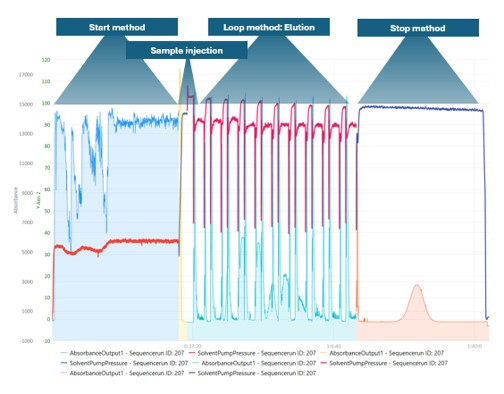
• CHROMControl takes over when the process starts. It communicates directly with the CPC equipment, executes the predefined instructions and allows operators to follow what is happening in real time. Key operating parameters, equipment status and process data are displayed and recorded throughout the run. The same control concept can be used across RotaChrom’s CPC portfolio, from laboratory equipment to industrial purification systems.

• CHROMViewer helps users understand what happened during the process. It provides access to the data collected during purification and presents it in a form that can be reviewed and compared. Users can look back at previous runs, compare chromatographic results and create reports, supporting both process evaluation and documentation.
Designed with Regulated Environments in Mind
For pharmaceutical and other regulated applications, operating the equipment is only one part of the job. It is equally important to know who did what, when it happened, and how process data was handled and stored.
RotaChrom Software Platform was designed with these requirements in mind. The platform integrates third-party GMP-approved software to support compliance with US FDA 21 CFR Part 11, EU GMP Annex 11 and other applicable GxP requirements.
This includes controlled user access, so different users can be given appropriate permissions based on their roles. Relevant system events, data changes and user actions can be recorded in an audit trail, providing a traceable history of what happened during operation.
Process data is handled in a structured way to support its completeness, consistency and traceability throughout its lifecycle. Backup and archiving capabilities also help ensure that important records can be securely stored and retrieved when needed.
Together, these capabilities provide a digital foundation for using RotaChrom CPC systems in environments where data integrity, traceability and controlled access are essential.
How Is the RotaChrom Software Platform Different?
Chromatography equipment and the software used to control it do not always come from the same developer. Many manufacturers integrate third-party control software with their hardware—a well-established approach across the industry, but one that adds an additional layer between the equipment and its control environment.
RotaChrom has taken a different approach. RotaChrom Control Software has been developed specifically for RotaChrom CPC equipment, meaning the hardware and software are designed as parts of the same system.
Why does that matter in practice? Because RotaChrom has direct control over both sides of the technology. When the equipment evolves, the software can evolve with it. When a system needs to be adapted to a particular process or configuration, changes are not dependent on the development priorities or compatibility requirements of an external software provider.
For users, this means a control environment built around the way RotaChrom CPC systems actually operate, with a consistent experience across different equipment scales and greater flexibility to support specific system configurations.
It also creates a foundation for long-term development. As new capabilities are introduced to RotaChrom’s CPC technology, the control environment can continue to develop alongside them—keeping hardware and software on the same path.