
Red Mesa Sets the Standard in Cannabinoid Purification with Industrial-Scale CPC
Partnership with Utah-based Red Mesa Science & Refining
In a rapidly evolving regulatory environment where traditional hemp refining methods face increasing scrutiny, centrifugal partition chromatography (CPC) is emerging as the gold standard for high-purity cannabinoid isolation. Among the pioneers embracing this transformative technology is Utah-based Red Mesa Science & Refining, a large-scale processor of hemp-derived CBD, CBG, CBN, CBT, and other rare cannabinoids.
Forbes recently interviewed Red Mesa President Jeff Applegate. Under his leadership, Red Mesa has become a leader in the cannabinoid space, specializing in CBD, CBG, and CBN isolates, distillates, crystal-resistant distillates, and botanically-derived rare cannabinoids.
Why Traditional Cannabinoid Refinement Methods Are Facing Challenges
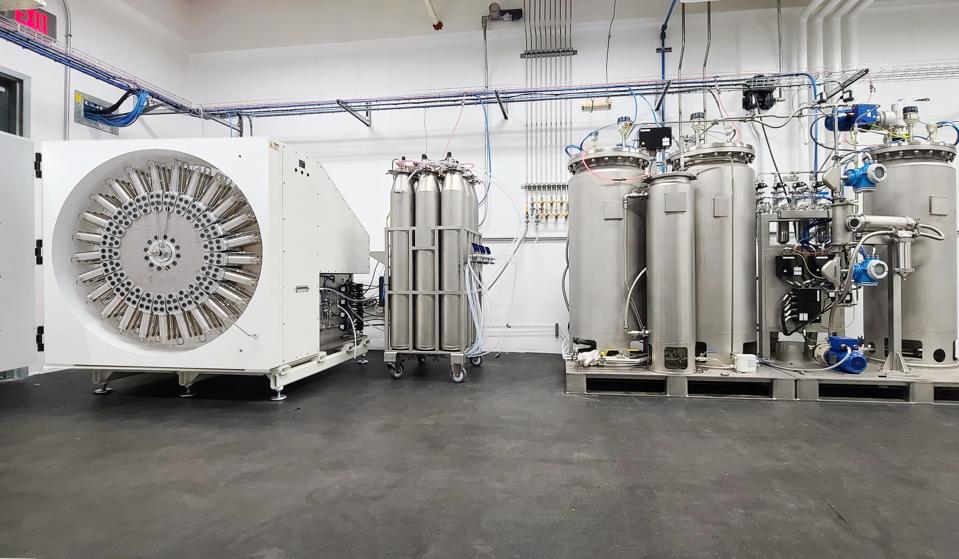
Recognizing the limitations of conventional purification methods that often rely on chemical catalysts or solid phases, Red Mesa adopted CPC as a scalable, cleaner alternative. Their novel botanical refinement process extracts and distills cannabinoids from American-grown hemp and then subjects the material to an industrial-scale liquid CPC system they purchased from RotaChrom Technologies. This enables precise isolation of specific cannabinoids without compromising their natural complexity.
„Unique to Red Mesa is the installation of the world’s largest centrifugal partition chromatography (CPC) equipment system.” said Red Mesa President Jeff Applegate.
How CPC Improves Cannabinoid Isolation and Purity
Unlike traditional column or flash chromatography, CPC uses two immiscible liquid phases and centrifugal force to separate compounds based on solubility differences, eliminating the need for chemical catalysts or solid supports. This results in higher selectivity, reduced contamination risk, and improved integrity of the final product.
“It’s highly selective, gentle, undelicate, and avoids contamination risk associated with those traditional methods of separation. The CPC allows us to refine rare cannabinoids like botanical CBN, CBL, and CBT and get exactly what we want. The perfect fraction is today a reality.” Applegate added.
A Science-Driven Approach to Botanical Refinement
The scientific rigor behind Red Mesa’s refinement methods is another key differentiator.
“We utilize techniques such as distillation, crystallization, and chromatography methods that allow us to separate and purify cannabinoids with precision without altering their natural structure. It is a science-driven approach that prioritizes quality and consistency,” said Brianna Jenkins, Director of Chemistry and Quality Assurance.
CPC Sets a Benchmark for Commercial-Scale Cannabinoid Production
In an industry where purity, consistency, and regulatory alignment are increasingly critical, Red Mesa’s deployment of CPC technology stands as a benchmark. Their success showcases not only the effectiveness of CPC for botanical applications but also its readiness for commercial-scale cannabinoid production.
Industrial-Scale Operations Supporting Market Demand
Red Mesa specializes in high-purity isolates and distillates, including crystal-resistant and THC-free formulations. Their operations, spanning a 50,000-square-foot facility, incorporate homogenization, distillation, crystallization, and now liquid-liquid chromatography at industrial scale.
The company’s ingredients primarily serve the hemp-based nutraceutical and wellness markets, where demand for regulatory-compliant, non-psychoactive cannabinoids continues to rise.