
How to increase chromatography productivity without buying a larger system
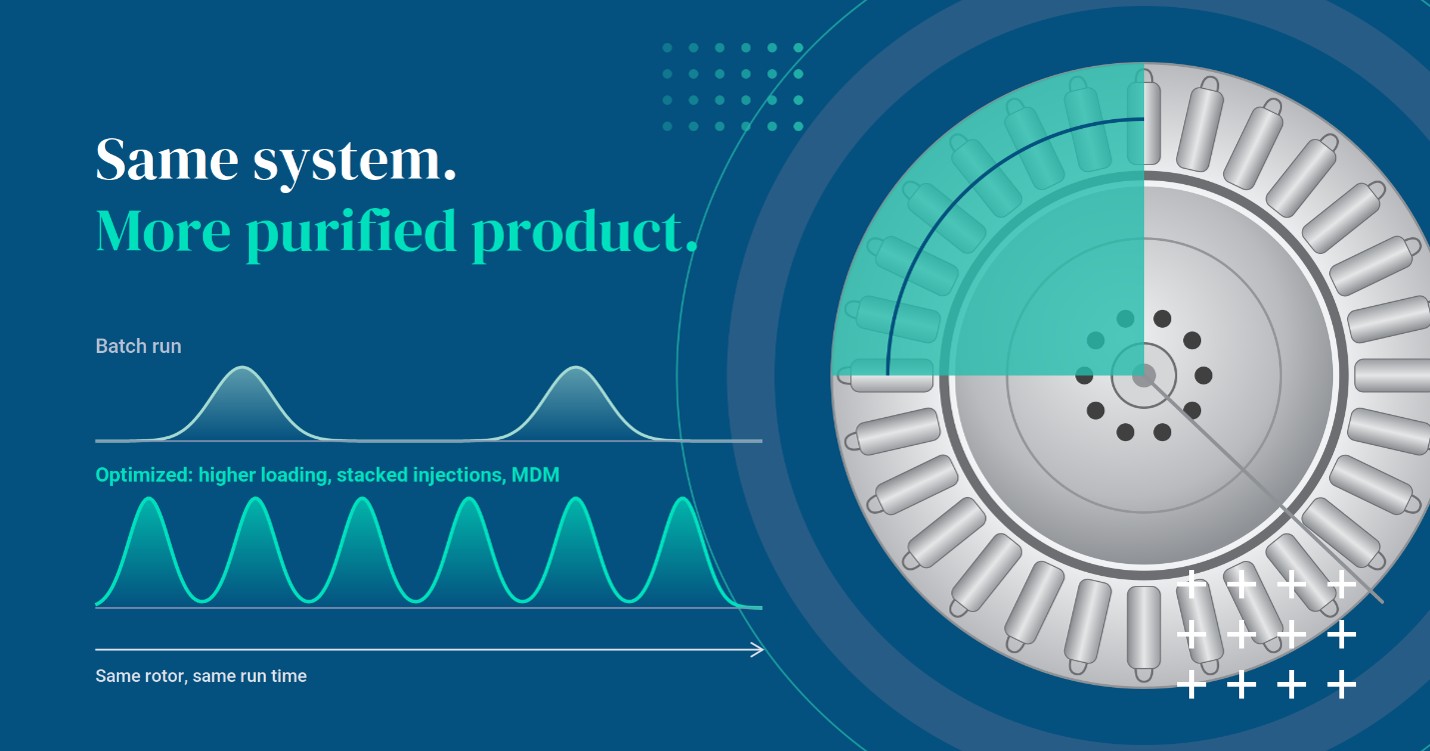
Most purification systems run well below their real capacity. You can usually raise throughput on existing equipment in six ways: optimize loading and the solvent system, shorten cycle time, use multiple dual-mode (MDM) operation for difficult separations, move from batch to continuous injection, improve fraction handling and solvent recovery, and scale out with identical units instead of scaling up.
What does chromatography productivity really mean?
Productivity is not just speed or purity. It is the amount of on-spec product you make per hour, per unit of column volume, together with the solvent used per gram. So the goal is to meet your purity specification at the highest possible throughput. Exceeding the specification at the cost of throughput does not help.
1. Get more product from every injection
Many methods stay at the conservative load they were developed at. A stepwise loading study often shows throughput can rise significantly before purity falls below specification. In centrifugal partition chromatography (CPC), the stationary phase is a liquid, not a solid support. This means loading is usually limited by sample solubility, not by stationary-phase capacity.
The solvent system matters just as much. Aim for a partition coefficient (K) for the target compound around 1, with clear separation from the nearest impurities. Better selectivity allows higher loading, faster flow and wider fraction cuts. All three raise productivity.
2. Run more cycles per day
Higher flow shortens each run. In CPC the limit is stationary-phase retention, so map retention against flow rate and rotation speed to find the optimum. Then look at the whole cycle, not only the elution. Stop runs once the target has eluted, and shorten equilibration where the process allows.
3. Use multiple dual-mode (MDM) CPC for difficult separations
When two compounds have very similar partition coefficients, standard runs reach their limit. MDM-CPC alternates between ascending and descending elution modes; the switching of flow direction and elution order makes it possible to separate complex mixtures and compounds with similar partition coefficients. The switch is made with a valve, and the cycle can be repeated until the compounds are fully resolved.
In practice, this gives the resolving power of a longer column on the same instrument. You avoid a second purification pass or a larger system. Read more about Multiple Dual-Mode CPC.
4. Move from batch to continuous injection
In batch mode, the system waits for each injection to finish. In continuous processing, feed and product discharge run without interruption. RotaChrom notes that this increases throughput while reducing solvent consumption, raw material requirements and downtime, lowering OPEX compared to batch processing.
Continuous CPC puts this into practice by connecting two rotors. Injecting in front of the rotors effectively increases column length and theoretical plate number, while injecting between the rotors enables truly uninterrupted sample feed.
5. Tighten fraction handling and recover solvents
Fractions that are too wide cost purity. Cuts that are too conservative cost yield. Use detector-triggered collection and fast in-process analysis. Recycle mixed side fractions into later injections instead of discarding them.
Solvent is often the largest running cost. In liquid–liquid chromatography, the phases can be collected, re-adjusted and reused. RotaChrom’s portfolio includes solvent handling platforms and automation solutions alongside its CPC systems.
6. Scale out instead of scaling up
If a single unit is truly at its limit, add another identical unit instead of moving to a larger one. RotaChrom describes scale-out as operating multiple CPC units in parallel or in continuous-loop configurations, so capacity grows stepwise and investment follows demand. The method transfers unchanged, validation stays simpler, and you gain redundancy. See Tech Transfer and Scale Up.
Where to start
Optimize the method first, then the cycle, then the operating mode and only then the hardware. Scaling out an inefficient process only multiplies its inefficiencies. To assess your options, you can model separations in silico with the CPC Simulator. The TCO Calculator compares the cost of each option, and a feasibility study tests your compound before you commit.
Frequently Asked Questions
+
Can I increase chromatography throughput without new equipment?
Yes. Higher loading, a better solvent system, shorter cycles and continuous injection often raise throughput substantially on existing systems.
+
What is multiple dual-mode (MDM) CPC?
It is a CPC technique that repeatedly switches between ascending and descending modes. This increases effective separation power for compounds with similar partition coefficients.
+
Is scale-out better than scale-up?
Often, yes. Identical parallel units keep the same validated method, add capacity in steps, and reduce the risk of downtime.