When the Matrix Is the Main Challenge: CPC for the Enrichment of Bioactives from Insect Larvae
Natural product purification rarely starts from a clean sample. In many cases, the real challenge is not only the target compound itself, but the matrix surrounding it. Lipids, pigments, degradation products, structurally related compounds and other co-extracted materials can make purification difficult long before final purity is reached. This is especially relevant for biological raw materials such as insect larvae.
The project was carried out in collaboration with the Institute of Pharmacognosy at the University of Szeged, the HUN-REN-SZTE Biologically Active Natural Products Research Group and RotaChrom Technologies Plc. The collaboration combined expertise in insect-derived natural products, analytical characterization and CPC-based purification strategy development. The central question was practical: if insect larvae can accumulate or transform potentially valuable bioactive compounds, how can these compounds be enriched from a complex biological matrix in a process-relevant way?
From bioactive potential to purification reality
Insect larvae are gaining attention not only as sustainable sources of nutrients, but also as biological systems capable of transforming and accumulating specialized bioactive compounds. In this project, enriched insect larvae were investigated as a potential source of insect-based bioactive conjugates, or IBB-Cs. Plant-derived precursor compounds can be metabolized by insects through detoxification and conjugation reactions, leading to transformed bioactive molecules that may be relevant for further biological, pharmacological or functional evaluation.
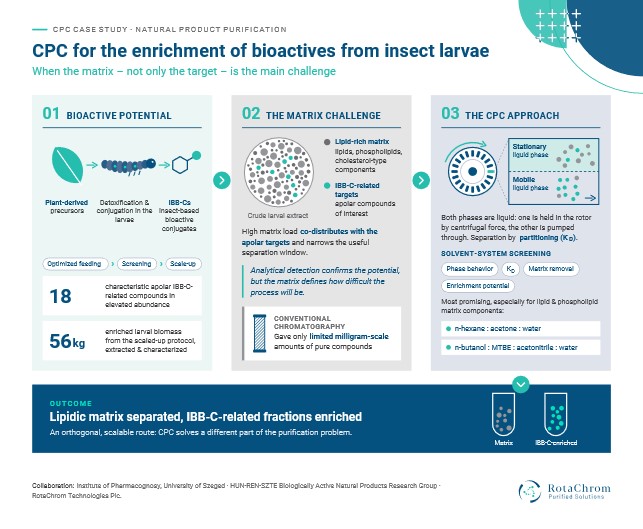
After optimization of the feeding conditions, analytical screening detected 18 characteristic apolar IBB-C-related compounds in elevated abundance. The best-performing protocol was scaled up, yielding 56 kg of enriched larval biomass, which was extracted and analytically characterized. At this point, the purification challenge became clear.
The target-related compounds were present, but the larval extract was dominated by a complex lipid-rich matrix containing lipids, phospholipids and cholesterol-type components. Conventional chromatographic purification provided only limited milligram-scale amounts of pure compounds, despite the promising analytical profile of the material. This is a typical natural product purification problem: analytical detection confirms the potential, but the matrix defines how difficult the process will be.
Why the matrix matters
In this type of extract, the lipidic matrix is not passive background material. Lipids, phospholipids and cholesterol-type components can be present at high load, co-distribute with apolar target-related compounds and narrow the useful separation window. This does not mean that conventional chromatography cannot be used. It means that the purification strategy has to address the matrix itself, not only the target compounds.
Packed-bed solid-phase chromatography and CPC approach this problem differently. Solid-phase methods rely on interactions with a packed stationary phase, while CPC separates compounds according to their partitioning between two immiscible liquid phases. For this reason, CPC was relevant in this project as an orthogonal tool for handling the lipid-rich matrix and enriching IBB-C-related fractions based on their partition behavior.
Where CPC fits
Centrifugal Partition Chromatography, or CPC, is relevant here because it approaches the matrix problem through liquid–liquid partitioning. Unlike packed-bed chromatography, CPC does not rely on a solid stationary phase. Both phases are liquids, and separation is governed by the distribution of compounds between two immiscible liquid phases. One phase is retained in the rotor by centrifugal force, while the other is pumped through the system.
For lipid-rich extracts, this is useful because the matrix and the target-related compounds can be separated based on partition behavior rather than interaction with a packed solid bed. The aim is not to treat CPC as a rougher version of another chromatographic method. The aim is to use a different separation principle when the matrix requires a different approach. Depending on the sample, solvent system and objective, CPC can support matrix depletion, enrichment, group separation, isolation or purification. Its role is defined by the separation problem, not by a fixed hierarchy between chromatographic technologies.
Solvent-system screening
For CPC, solvent-system selection is the central method-development step. In a complex matrix, a suitable solvent system must do more than give a convenient partition coefficient for one target molecule. It has to create a useful separation window (sufficient selectivity) between the target-related compounds and the major matrix components.
In this project, several biphasic solvent systems were evaluated based on phase behavior, partitition coefficients (KD), matrix removal and enrichment potential. Among the tested systems, n-hexane:acetone:water and n-butanol:methyl tert-butyl ether:acetonitrile:water showed promising separation behavior, especially for lipid and phospholipid matrix components. This result is important because it shows where CPC added value in this study: by changing how the complex crude extract could be handled.
What this project shows
This project highlights an important point in natural product purification: the sample matrix often defines the method-development strategy. For enriched insect larvae, the dominant limitation was the lipid-rich background, not the analytical detectability of the target-related compounds.
CPC was therefore evaluated as a way to address this matrix-driven purification problem through liquid–liquid partitioning and solvent-system selectivity. CPC provided an orthogonal approach for handling this matrix and enriching IBB-C-related fractions in a scalable way.
For natural products, functional ingredients, biotechnology and pharmaceutical research, this can be especially valuable when the matrix, not only the target compound, defines the purification challenge.
Conclusion
For insect-derived bioactives, the main purification challenge was not only the target compound, but the lipid-rich matrix around it. This collaborative project showed that CPC can address this type of matrix-driven problem through liquid–liquid partitioning, supporting lipidic matrix separation and enrichment of target-containing fractions. That is the value of CPC in complex natural product purification: not doing the same job differently but solving a different part of the purification problem.