
Continuous chiral CPC in practice: Process intensification for voriconazole enantioseparation
A cyclodextrin-mediated chiral CPC (centrifugal partition chromatography) process was developed for rac-voriconazole and successfully intensified from batch to cyclic continuous and continuous MDM (multiple dual mode) operation using Continuous CPC. The study demonstrates that continuous chiral separation by CPC can be achieved while maintaining chiral performance throughout intensification, delivering 99.8% purity, 99.9% ee (enantiomeric excess), 81% isolated yield, and an approximately 25-fold productivity increase over classical resolution.Chiral purification at manufacturing scale is still dominated by classical resolution and, in selected cases, preparative chromatography. These routes can be robust, but they are often constrained by batch operation, downstream cleavage or work-up, and limited productivity.
In our recent study ( A. Kiss, D. Rutterschmid, S. Muráth. Sep. Purif. Technol. 2026), rac-voriconazole was applied as a demanding model system to show that chiral CPC can be intensified from batch to continuous operation, establishing a technically credible route toward productivity-oriented, continuous chiral chromatography.
Selector-Driven Enantiodiscrimination in Liquid–Liquid CPC
The technical premise is straightforward. In CPC, both phases are liquids, so chiral recognition is governed by selector-dependent partitioning rather than interaction with a solid chiral stationary phase. Cyclodextrins (CDs) are cyclic oligosaccharides that act as soluble chiral selectors by forming transient host–guest complexes with analytes in the aqueous phase. In chiral CPC, this enables enantiodiscrimination through differences in selector-dependent partitioning between the two liquid phases. Because the cyclodextrin remains confined to the aqueous phase, the target product can be recovered in the organic stream without a dedicated selector-removal step. As a result, the isolated product is essentially CD-free, which simplifies downstream processing.
Process Development and Intensification Toward Continuous Chiral CPC
The development work was structured to move chiral CPC from initial method development on CPC Modeler toward an intensified, industrially relevant process. Batch experiments served only as a necessary foundation for identifying solvent system and chiral selector combination capable of stable hydrodynamics, effective enantiodiscrimination and compatibility for further intensification.
From this basis, the process was advanced into a cyclic continuous stacked-injection workflow, in which the selector rich stationary phase was retained in the rotor unit for consecutive injections, furthermore recyclability studies were successfully conducted on pilot-scale. This demonstrated that chiral CPC can move beyond conventional batch operation toward more productive use of the system while maintaining separation performance.
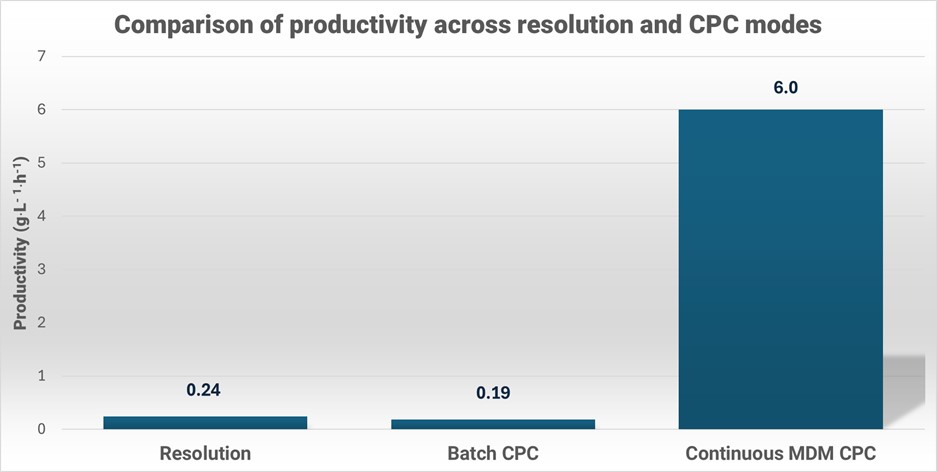
The key intensification step was the transfer of the method to our Continuous CPC platform operated in MDM mode. This dual-rotor concept, based on repeated ASC/DSC switching and dual-outlet fraction collection, enabled genuinely continuous chiral separation rather than repeated batch injections. In its final intensified form, the process achieved 99.8% purity, 99.9% ee, 81% isolated yield, and 6.0 g·L⁻¹·h⁻¹ productivity (see Figure 1.).
Toward Industrial Chiral CPC: Productivity and Downstream Simplification
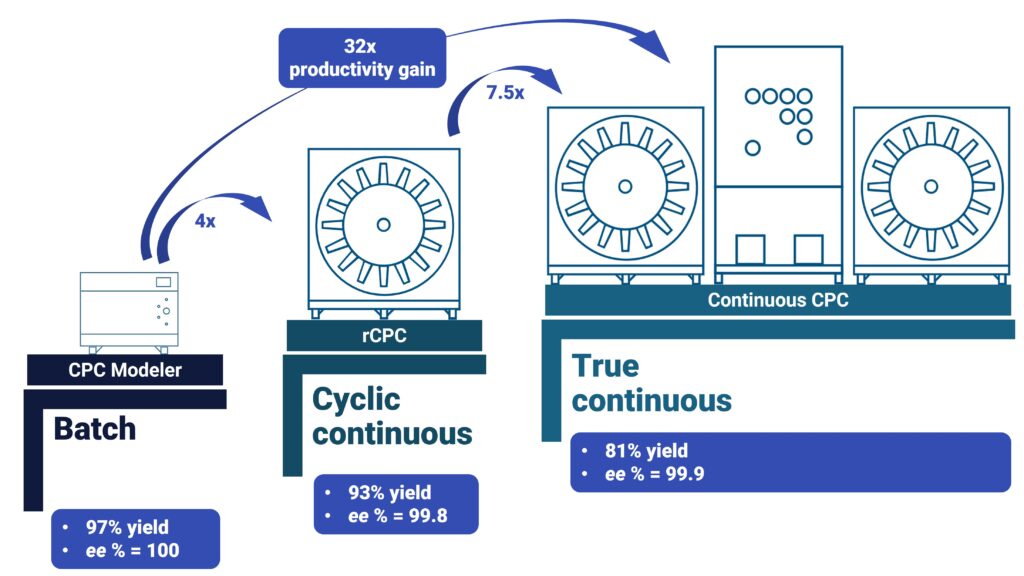
From a process-engineering perspective, the main result is that voriconazole enantioseparation by CPC can be intensified stepwise from batch to cyclic continuous and then to continuous operation while maintaining chiral performance. Relative to classical resolution, the continuous MDM workflow increased productivity by about 25-fold. Relative to cyclic continuous operation, it increased productivity by 7.5-fold. This positions continuous chiral CPC as a technically feasible and industrially relevant route for intensified enantioseparation (Figure 2.).
A second important outcome is the downstream simplification built into the phase design. Since the selector remains in the aqueous phase and the target is collected in the organic phase, the process avoids a separate decomplexation or selector-removal operation. This simplifies product isolation and creates a practical basis for solvent and selector-phase reuse. In the stacked-injection and pilot-scale recycle experiments, the selector-rich phase remained operationally usable without loss of meaningful separation performance.
CPC as a True Process Solution
Technically, this study shows that CPC is more than a batch option for niche chiral applications. It shows that selector-mediated liquid-liquid chromatography can be engineered toward sustained, manufacturing-relevant operation. For challenging chiral separations where throughput, selector economy, and downstream simplicity matter, continuous CPC deserves to be evaluated as a real process option rather than only as an analytical curiosity.
Learn More About Isomer separation
CPC continues to gain traction as a versatile and cost-effective alternative to traditional and advanced chromatographic methods alike. To explore more about this innovative technology, check out the following resources: